Monday, June 3, 2019

The Return of the Herring

“This is really amazing, it’s a historic event,” says John Kilborn, a resident of Winchester, MA who advocated for one of the nearby fish ladders that got established in 2017 in Winchester Center in Eastern MA, “Because of the cleaner water and new fish ladders, the herring are appearing where they haven’t appeared in at least a hundred years.” (1)


Source: Maine Dept. of Marine Resources

What are river herring?
They are fish that live the majority of their lives at sea, but migrate upstream in early May through June to spawn and lay eggs before returning to the ocean. Their historic range was all along the Eastern seaboard from Florida to Nova Scotia. There are two main
types most common in the Mystic River, the "Alewife" and the "Blueback" herring. The Maine Department of Marine Resources writes about the more common Alewife species, saying, "Between and within those various habitats [from sea to stream to pond and lake], everything eats alewives: striped bass, bluefish, tuna, cod, haddock, halibut, American eel, brook trout, rainbow trout, brown trout, lake trout, landlocked salmon, smallmouth bass, largemouth bass, pickerel, pike, white and yellow perch, seabirds, bald eagle, osprey, great blue heron, gulls, terns, cormorants, seals, whales, otter, mink, fox, raccoon, skunk, weasel, fisher, and turtles." (2) Herring are, in some ways, the life blood of the river, fueling an entire ecosystem. They are an indicator species.

The Mystic River watershed in Eastern Massachusetts borders 22 different communities as it flows out to the Atlantic ocean and for years the river had received very poor water quality ratings. It was a combination of industrial pollution, street and fertilizer runoff, flooding, development (including dams), sewage outfall after heavy rain events... so many factors that hurt both the river, the human communities along the river, and dropped herring populations to all time lows. Most people though of the river as a waste stream as a opposed to a vital part of the community.

In recent years, however, the Mystic River Watershed Association (MRWA) has been working to change that and bring back the ecological function of the river, despite being in a densely populated urban and industrial area within the Greater Boston Area. The MWRA is striving to turn the Mystic from a problem into part of a resilient solution. Bit by bit, the organization has worked with communities and organizations and volunteers to change the way people interact with the river.

Before the fish ladder was added in Winchester Center (and before other fish ladders were installed before that!), volunteers from MWRA who knew the fish and recognized their importance had tirelessly helped the fish cross the impenetrable dams by catching as many as they could in 10 gallon buckets (The Bucket Brigade) and releasing them over the dam so they could get to their spawning grounds. 20,000 fish, maybe, might make a typical migration through Winchester in the early 2000's. One year an oil tanker (that refilled home heating units) even crashed and spilled in one of the narrow upstream branches in the river. People worried it was the end for the herring. But they came back. As awareness has grown and fish ladders have been put in many places in the lakes, reservoirs and ponds in the Mystic and Aberjona Rivers, the herring have responded in droves. (1)

In fact, 2017 saw the largest recorded herring run in the past hundred years! Around 630,000 herring made it to their native spawning grounds! And with the herring come swarms of blue fish, cormorants, black crowned night herons, bald eagles, and osprey who feast on the herring, a major food source for the watershed. They are an indicator species of the health of the watershed. They even have a symbiotic and very specific relationship with certain native freshwater mussels (such as the "Alewife Floater") that hitch a ride on the fish's gills before dropping off to settle down upstream. Mussels help filter and purify water. Their are even studies documenting herring reducing phosphorus levels (a major water pollutant) in the water. (2) So counter to what one might imagine if you added lots of fish to a waterway, the herring actually leave the rivers cleaner than when they arrived. As Erica Wood, communication manager of the Mystic River Watershed Association says, it is one of the largest herring migrations in the region and it is happening in a densely populated urban area. “This migration is happening right in our backyard and not a lot of people know about it." (1)

2018 saw even more herring at over 750,000 from volunteer and fish cam counts! Another record set. The river is coming back to life.

And now in 2019, they are estimating over 1 million.
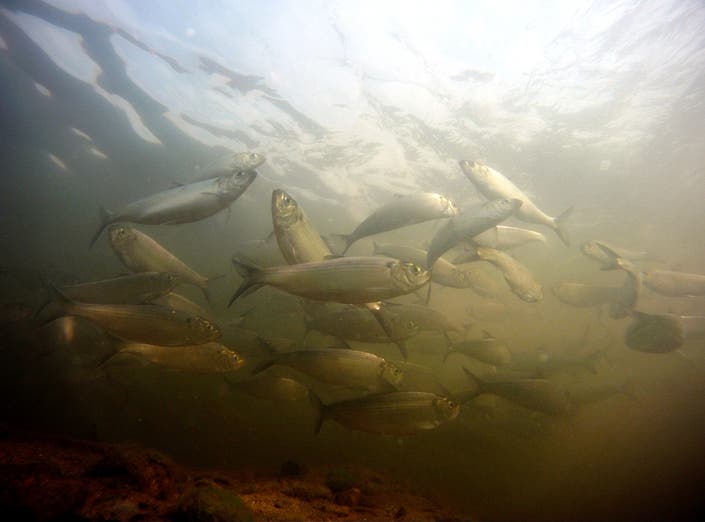


The Return of the Herring!
Source: Watch Mystic River Herring Migration and Help Count the Fish! (4)

Read More Here:

1)"Winchester Center Sees One of the Largest Herring Migrations" by By Mariya Manzhos. Mystic River Watershed Association. https://mysticriver.org/news/2019/2/15/winchester-center-sees-one-of-states-largest-herring-migrations

2) Maine River Herring Fact Sheet (including pictures) - https://www.maine.gov/dmr/science-research/searun/alewife.html

(3) "Freshwater Mussels and the Connecticut River Watershed" by Ethan Jay Nedeau 
https://www.ctriver.org/product/freshwater-mussels/

(4) "Watch Mystic River Herring Migration and Help Count Fish!" By Mike Carraggi, Patch National Staff | https://patch.com/massachusetts/arlington/watch-mystic-river-herring-migration-help-count-fish

Thursday, May 23, 2019

Saving the Atala Butterfly (by Accident?)

Atala butterflies were once thought to be extinct. It was a sad story and yet all too familiar. Their host plant, the coontie, fell prey to both commercial overharvesting as an edible starch in the 1900s (it had been harvested sustainably for generations before that time!) and severe loss of habitat due to development of the pineland forests where the native coontie was predominantly found. Atala butterflies, like many other beautiful and beneficial bugs, often develop specific relationships to native plants that they have evolved to be able to eat. With the Atala butterfly, its young could only eat the once-abundant coontie plant, and as the numbers of these plants dwindled, so did the butterfly. It got to the point where no one had seen an Atala butterfly for many years and they were widely believed to have gone extinct. It would have been an all too familiar tragic story...

But it doesn't end there.

It turns out the coontie plant or "coontie palm" as it is also called, is a beautiful, hardy, drought resistant and ancient plant which is also resistant to most pests and disease (the Atala butterfly did a remarkable thing when it evolved to eat this difficult-to-digest food source!). And landscapers became to notice how attractive they looked in people's yards. Soon people all over South Florida began incorporating the coontie into their yards.

And amazingly, the butterflies came back! They were just a few hidden somewhere, somehow all those years in a far off patch of pine forest where some stray coonties still grew. It was enough. The butterflies slowly at first, but have now returned in huge numbers. To the point where some landowners began calling in about the new "pest" on their coontie plants. The University of Florida's IFAS Extension gives recommendations on how to lightly manage the caterpillars if they begin to overwhelm young coontie plants and how to move them (or sell them to people who now want the butterflies!) to continue to rebuild both the populations of coontie plants and Atala butterflies.

It may just be one species, an ephemeral insect that lives for just a little while in our world. Yet the Atala butterfly is more than that. It is a thing of beauty, yes, but also, in its small but determined way,  it is a resilient piece in this world. Like us, it depends on the environment around it and is part of the interconnected web of life that we also call home.

And, if this could happen by accident, just imagine what we could do if we tried...


Credits:Saving the Atala Butterfly: A Success Story. Horticulture Magazine. https://www.hortmag.com/blogs/editors-blog/saving-atala-butterflies-success-storyFlorida Coonties and Atala Butterflies. Daniel Culbert. University of Florida, IFAS Extension. https://edis.ifas.ufl.edu/pdffiles/MG/MG34700.pdfPictures:1) An Atala butterfly (Eumaeus atala). Photo by Scott Zona [CC BY 2.0], via Wikimedia Commons.
2) Coontie Plant: 
https://www.south-florida-plant-guide.com/coontie.html
3) Atala Caterpilalr http://www.butterflyidentification.com/atala.htm


Thursday, January 17, 2019

A Lifetime of Trees

Several years ago I went to a funeral of a woman I had know for years. She was an older friend of mine who lived simply in a small town in the midwest. The town was in the Plain States surrounded by miles and miles of fields, mostly corn and soybeans. The land was dry and hot most summers unless it rained which often caused flooding even with what felt like only moderate amounts of rain. Yet the little town was full of trees: a refuge from the intensity of the heat, absorbing the rainfall like a sponge, and even in winter (although I had only once been to visit my friend in winter) the trees felt like protection from the harsh cold winds that blew relentlessly over the fields. I never paid the trees much attention beyond a passive gratitude for refreshing shade on hot days and never considered the fact that almost every tree in the town was under fifty years old. That is, until this funeral service of my good friend.

At June's funeral, many people got up and spoke about her kindness, her love of people and place, her commitment to community and family. All this I had known to some extent. But it wasn't until the end of the service when a longterm friend and neighbor spoke, that I really sat on the edge of my seat. He was a soft spoken man with graying hair and kind eyes. When this man had moved to town, he said there were very few trees. The winds were too strong, the conditions a bit harsh for trees of any suitable size, at least, that is what the consensus was at the time. And yet June was convinced it was possible. He met June for the first time on their shared street as she was planting seeds. She persisted in planting, he said, despite the brutal conditions and lack of success of some of those first seedlings. In the beginning she used to go out at dusk when it was cool or just before a predicted rain storm and plant: acorns, nuts, maple, cherry or apple seeds. The first few years were rough, he said, but she persisted doggedly. The town governance at the time was in full support, though skeptical, but didn't have funds to tackle a town-wide tree-planting. In the early years she eventually received rewards for her planting efforts, especially as her success became ever more apparent. Over time however, as the terms of office shifted and more newcomers filtered through the town and the trees grew, her efforts were forgotten and very few knew that it was June who had planted and kept planting the trees in town. Or that only a few short decades earlier there had been hardly any trees at all in town. Yet this never stopped her or dampened her enthusiasm and love of trees and flowers, too. In fact, she seemed to prefer avoiding the limelight and kept quietly planting. She always carried a small bag of seeds, so he said, with her in a pocket or purse.

This man described how year by year he would watch the songbirds that migrated through in spring  come back in greater and greater numbers despite the national records saying their populations were decreasing nationally. His eyes lit up as he talked about the pair of Orchard Orioles that eventually came back year after year to nest in his own backyard a tree that June had helped him plant. "The impact of the life of a single person" he said softly, leaning into the microphone in the front of the room, "cannot easily be measured in one way or another. Though to me it feels as though June is with us still in the trees she left behind. She's in the colorful songbirds and butterflies and the richer soil below us. It feels as though each footprint she left behind is blooming still."

There was a respectful silence as June's neighbor nodded a thanks to us all and returned to his seat. It felt deeper than the silences that had followed the previous speakers and with it came an unspoken invitation to continue the work June had begun. It was as if each one of us was trying to imagine the town without its wealth of trees. In essence, June had single-handedly planted an urban forest. How many trees were there? Hundreds? Could it be thousands? I felt the impact of her life resonate within my own and a profound gratitude to this man I didn't know. 

After the funeral I walked through the town looking at the trees, the flowering shrubs and woody perennials. I had known June for years, but never knew that it was she who was solely responsible for nearly all of the trees in town. I felt the gift of her life more strongly, more palpably than ever, as if she was still with us in the the very trees she had planted. Every tree began from a seed and June had extensively collected seeds, transplanted saplings, and tended the trees of this small town until they were able to stand on their own. Instead of dry and dusty and hot in summer, the town center was cool, shaded and beautifully refreshing with the oaks, maples, basswood, cherry, apple, hickory, ash, spruce, pines, hemlocks, alders, birch, sycamore, walnuts, butternuts and locusts!

Could June have been a Sparrow, I thought? A Sparrow in spirit at the very least! How many others were out there, I wondered. How many forests were grown in the matter of decades by people like June? Perhaps I'll never know, but it gave me a thrill just to know there might be others out there quietly planting forests one seed or sapling at time.

Friday, December 7, 2018

A Chance Encounter


There was something different about the woman standing a few tables away from me. As she gracefully sat down on the wooden chair, I thought I heard the clink of metal and a quick glimmer of steel and something like a sword at her waist under her coat. Her face was weathered and her hair braided back firmly behind her head. She picked up the glass of water offered with a nod of thanks and with hands weathered and strong.
            She was one of the Sparrows. I suddenly realized she must be one of them from the Sparrow Underground. I saw the sacks of seeds tied discretely at her waist just visible under her coat and wondered at seeing her here in the city so far from the forests and the wild. I had always heard the stories, but never seen a Sparrow in person. People said birds landed and spoke to them. People said they knew the words to whisper to bring fish teeming back to rivers and how to coax plants out of barren soils. They said the Sparrows could make the deserts bloom again, great forests regrow, and springs burst back to life in the drylands. I had no way of knowing how many of these stories were even remotely true. I had always dismissed them myself. Until now. Seeing her sitting there, I could almost make myself believe the stories were true.
            As I was watching her with all these thoughts swirling through my head, she looked up straight at me. My breath caught in my throat. She smiled, raised her glass in my direction, a subtle half greeting, half salute, before finishing the water in it. No one around me seemed to even realize she was there. I wanted to get up and sit beside her and ask to hear her story because everything in the way she moved told me she had a story and a good one at that, but I wasn't so bold a person in those days. She thanked the man at the bar who had given her the water and stood, her dusty traveling coat falling to her sides. She glanced in my direction and untied a small cloth satchel from around her waist. She deliberately placed it on the table, nodded at me with a hint of a smile flickering across her face and left. 
            To this day, I still kick myself for not having had the courage to go talk with her. I did pick up the satchel of seeds she left me, though it was several years before I finally found out what they were. That was the first time I saw a Sparrow, but it wouldn't be the last. 

The Return of the Herring

“This is really amazing, it’s a historic event,” says John Kilborn, a resident of Winchester, MA who advocated for one of the nearby fish l...